About Us
Recent research on lifestyle-related interventions suggests that understanding setting (also referred to as context or environment) is central to the success of public health programs, policies, and practice. This means that the places where program and policy initiatives occur are just as important as the design of an intervention and the characteristics of the people involved.
The social environment, the built (or physical) environment, and an individual’s characteristics and behaviours work together to shape opportunities and barriers for individual and community health. Where a person lives, when and how they access the things they need in their daily life, and the policies that create their social, political, and economic environments all matter for his or her health. Therefore, understanding the relationships between people, policy, and place is essential for health promotion and public health.
The purpose of the Policy, Location and Access in Community Environments (PLACE) Research Lab is to systematically investigate relationships between people-policy-place by developing, evaluating and mobilizing evidence about population health interventions and other strategies that promote lifelong health and chronic disease prevention.
Work in the PLACE lab involves community-based participatory research, qualitative and quantitative methodologies, and geographic information systems (GIS) mapping.
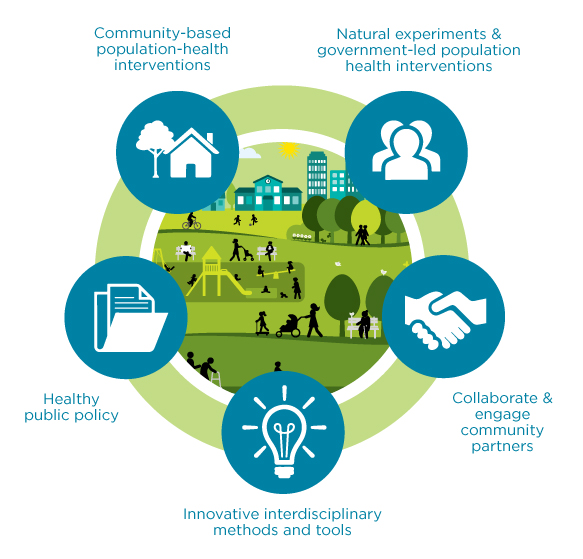
PLACE research activities span five key areas:
- settings-based approach to implement and assess community-based population health interventions on built, social or policy environments, relative to health outcomes;
- investigate how natural experiments and government-led population health interventions impact health and health equity;
- design, validate, and use innovative interdisciplinary methods and tools to assess the built, social and policy environments;
- support healthy public policy development at multiple levels; and,
- collaborate and engage community partners to support relevant, timely and accessible development of knowledge.
Dr. Candace Nykiforuk is the Lead Investigator of the PLACE lab.